
Theory of Reflexive Consciousness

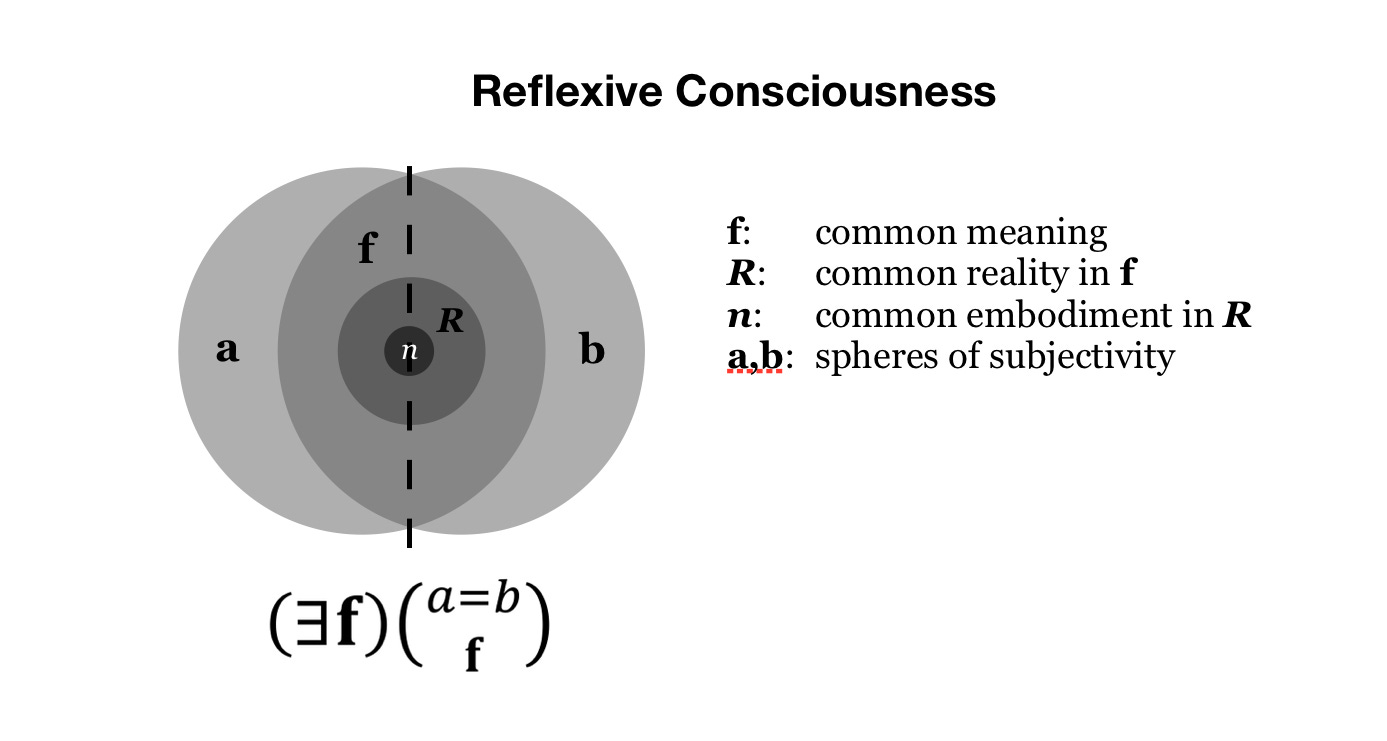
I understand reflexive consciousness as the capacity to identify thoughts and intentions as belonging to a temporally continuous, singular identity, and to be able to have thoughts and realise intentions with respect to that identity, including its thoughts and intentions. In Ontological-Transcendental Defence of Metanormative Realism I argued that direct (monadic) self-reference is logically impossible and presented a model of conscious agency based on indirect, socially mediated self-reference, involving the synthesis of individual difference and the common identity of a social kind. In this article I explain reflexive consciousness with the focus on schematic representation.
An individual cannot relate to self all by itself. We exist as conscious selves vis-a-vis other beings of the same kind, whose recognition as conscious beings depends on commonality and reciprocity of meaning. An individual a is reflexively conscious only if a relates to itself by relating to a different individual b that relates to itself by relating to a, in terms of properties f common to them both, and a is not identical to b. In the above diagram it is assumed that reflexive relations between a and b are perfectly consistent (a identifies with f in b as much as f in a, and b identifies with f in a as much as f in b), which implies that a and b are fully integrated selves, with the maximum degree of existence as conscious agents. Any inconsistency in identifying with f would create a reflexive inconsistency in the self, a meaningless void or a disassociation in self-identity, therefore incomplete self-reference, resulting in diminished reflexive consciousness. The present model is limited to only two individuals, but any number of individuals can maintain reflexive relations by means of a common part. The range of meaning held in common includes common reality, and the common reality includes common embodiment (f⊃R⊃n).
Informally, a conscious individual could not recognise another individual as conscious without sensing their point of contact (reality) as something held in common and serving as a common reference; without a common sense of being there could be no correspondence of sense, no possibility of agreement about what is sensed, therefore no socially mediated reflexive relating and no Self. If individual consciousness is conditional on the consciousness of others, it cannot be fully encoded in the individual body but is determined simultaneously by internal and external factors. On this view, we sense others as instances of ourselves, physically autonomous, with different points of view and different experiences, but sharing the same process of consciousness.
It follows from the previous inference that it is impossible to create consciousness by creating a brain outside of the process of embodied evolution and socialisation. Consciousness is coextensive with meaning, and meaning cannot be discovered or given because it is not something beyond consciousness but within it, something that is socially generated via countless mutations of prior meanings, and as such requires common conceptual continuity from the beginning of consciousness. Consciousness co-evolves its own, common reality and embodiment.
The scope of common meaning can vary between communication-communities, ranging from the basic survival/sexual co-dependency to complex systemic abstractions. In the hierarchy of reflexive orders, the common embodiment is a grounding condition for the more abstract orders of commonality. In the case of non-reflexive awareness of other individuals of the same kind, f and R are coextensive with the awareness of common embodiment.
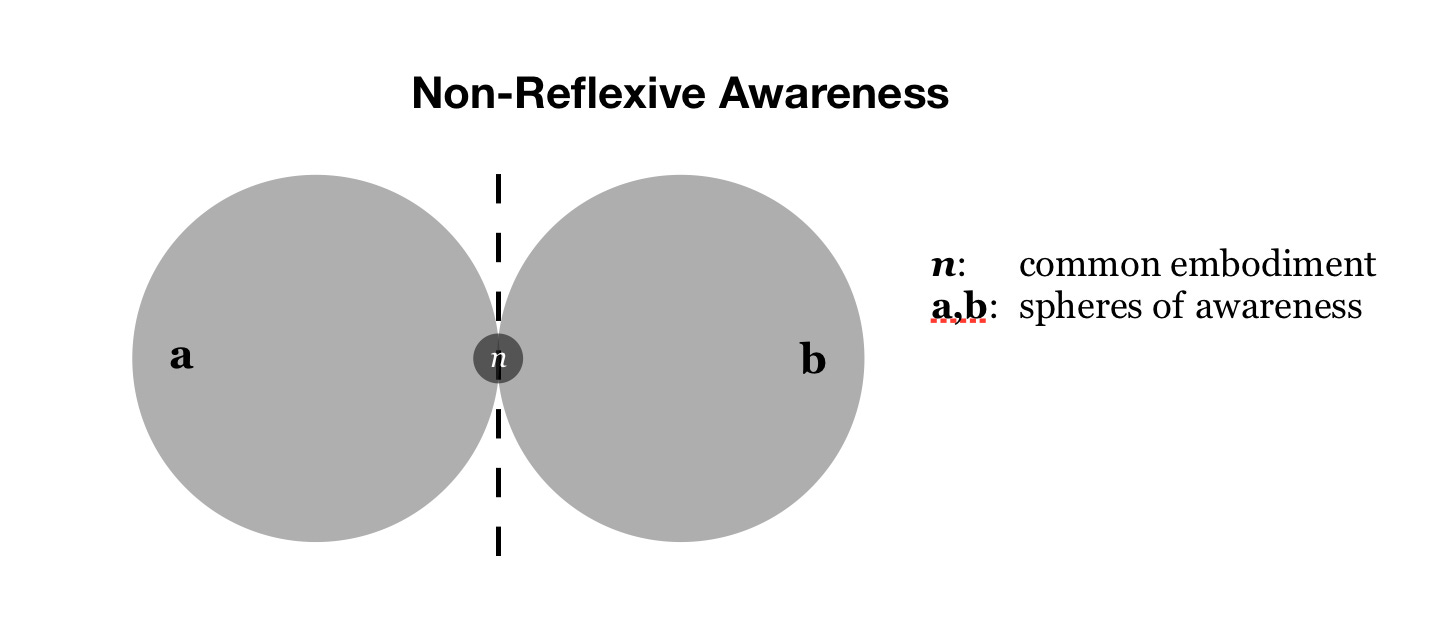
The remaining challenge may be to explain how non-reflexive awareness could evolve into reflexive consciousness. On the other hand, since consciousness encompasses every theory and concept, including the concept of time, the theory of consciousness does not need to accommodate a non-conscious source or beginning, although it does require a theory of time that is consistent with the theory of consciousness. For a broader discussion of this topic please see my book Moral Ontology: a thesis on the interdependence of sense, integrity and agency.
ADDENDUM (19.07.2025)
Consciousness is intrinsically a reflexive multiplicity, where every instance of consciousness - a point of view embedded in the narrative continuity of events - continuously attempts to conceive of itself in relation to others, but in doing so it inescapably augments itself. The Self-relation is therefore essentially incomplete: the idea of Self is not identical with the instance of consciousness that is conceiving of it.
Emergence of thought is a process whereby consciousness attempts to grasp itself, to mirror itself, to complete its self-ideation in terms of meaning held in common with other instances of consciousness, and thus perfect itself.
Another way, every instance of consciousness is logically incomplete and unstable in its self-ideation and seeks to stabilise itself by relating with other instances of consciousness. Whenever inconsistency in Self-ideation is identified, a thought arises to compensate for this imperfection, to maintain the tentative integrity of Self. Every desire is ultimately motivated by the intrinsic aim of consciousness: to perfect itself.
Crucially, our responses to inconsistencies of Self-ideation influence how we may respond to future realisations of inconsistency, steering our thoughts either towards greater stability of self-ideation or towards catastrophic instability. This process is governed by the laws of sense, insofar as the integrity of Self-ideation (the sense-unity of Self-in-the-world) reflects the degree of compliance with the laws.
There is a commonality between how insects or birds recognise other members of the same species and how humans recognise other humans. It would not suffice to rely on sight or smell to identify our kind without already knowing what to look for. It is this additional knowledge that cannot be discovered but is intrinsic to the species. In the case of animals, attraction to same species is unconsciously embodied, as a common sense; consciousness of the common kind emerges from this common sense. Nevertheless, this interpretation is also retroactive: consciousness creates the meaning of the conditions that gave rise to it.
I don’t know that a newborn human possesses any parental memory either, and “evolutionary roots of common embodiment” seems, shall I say, fanciful. I did look it up:
“Within cognitive psychology, it is used to suggest that features of the physical body play an important causal role in cognitive processing.”
https://link.springer.com/chapter/10.1007/978-3-030-78471-3_24
What it further suggests is there was never a beginning to awareness until some time after humans (not necessarily homo sapiens) existed.
I would easily agree that as machine “thinking” would not be very similar to thought processes of biological individuals, their world would necessarily be different. I’ll read your included link, but I can’t imagine for what reason it would not exist, to us.